
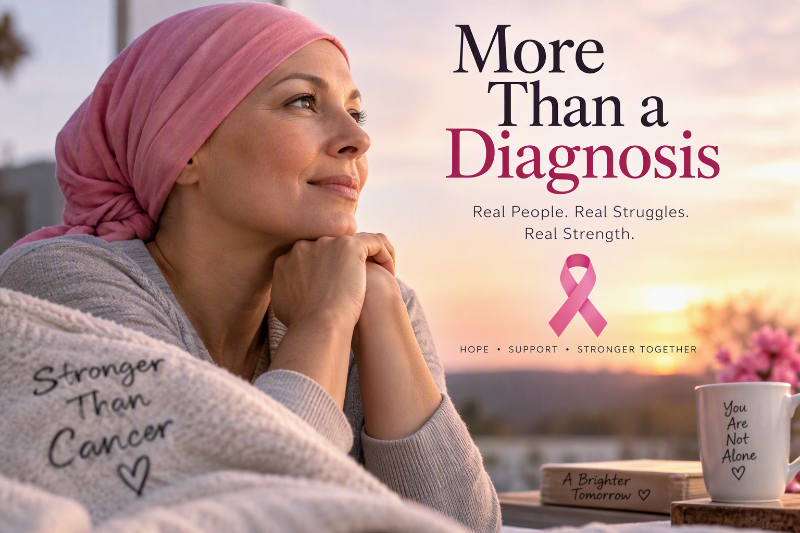

The Silent Battle: Understanding the Emotional Struggle of Breast Cancer
Breast cancer affects the body, but it also touches the heart, mind, identity, and spirit of the person facing it. While medical treatment focuses on removing or controlling the disease, emotional healing often becomes an unseen struggle that can last long after the final treatment ends.
More Than a Diagnosis
The moment someone hears the words, “You have breast cancer,” life changes instantly. Time seems to stop. Thoughts race. Questions flood the mind.
“Am I going to survive?”
“What will happen to my family?”
“Will I ever feel normal again?”
A breast cancer diagnosis often creates an emotional earthquake that shakes every part of a person’s life. Fear, uncertainty, sadness, anger, and even disbelief can become daily companions. While loved ones may focus on treatment options and survival rates, the individual diagnosed is often carrying a much heavier burden internally.
Research has consistently shown that anxiety, depression, fear of recurrence, and emotional distress are common among individuals diagnosed with breast cancer (National Cancer Institute, 2025; American Cancer Society, 2025).
The Losses No One Talks About
Many people assume the greatest challenge is chemotherapy, radiation, surgery, or physical pain. Those experiences are difficult, but many survivors describe another type of pain that is harder to explain.
Breast cancer can create a sense of loss.
Loss of certainty.
Loss of normalcy.
Loss of control.
Loss of identity.
For some women, surgery can impact body image and feelings of femininity. Looking in the mirror may become emotionally painful. Hair loss from chemotherapy can make the illness impossible to hide and can change how a woman sees herself.
The struggle is not vanity.
It is grief.
It is the mourning of a body that suddenly feels unfamiliar.
Living With Fear
One of the most exhausting emotional experiences associated with breast cancer is fear.
Fear often arrives in waves:
- Fear before surgery
- Fear while waiting for test results
- Fear during treatment
- Fear when treatment ends
- Fear that the cancer may return
Ironically, many survivors report that anxiety increases after treatment. During active treatment, there is a plan and a medical team actively fighting the disease. Once treatment ends, many people feel as though they have lost their safety net.
Every ache, pain, or unusual sensation can trigger questions.
“Is it back?”
This phenomenon, often called “fear of recurrence,” is one of the most common emotional challenges reported by cancer survivors (NCI, 2025).
The Weight of Being Strong
Many individuals with breast cancer feel pressured to appear strong for everyone around them.
They smile when they are scared.
They reassure family members while secretly struggling.
They thank others for support while feeling emotionally exhausted.
People often praise cancer patients for being “brave” and “strong.” While those comments are usually well-intentioned, they can unintentionally make it difficult for someone to admit they are hurting.
Being strong does not mean never crying.
Being strong does not mean never feeling afraid.
Being strong does not mean carrying every burden alone.
True strength is often found in allowing vulnerability and accepting support from others.
The Impact on Relationships
Cancer affects entire families.
Spouses frequently experience fear and helplessness as they watch someone they love suffer. Children may struggle to understand what is happening. Friendships sometimes become stronger, while others unexpectedly fade.
Relationships can face challenges when emotions are not openly discussed. A patient may feel isolated, believing that no one fully understands their experience. Family members may want to help but feel unsure of what to say or do.
Open communication is critical during this time. Sometimes the most meaningful support is not advice or solutions. It is simply sitting beside someone and listening without trying to fix their pain.
The Hidden Grief After Treatment
Many people expect celebration when treatment ends.
Surprisingly, some survivors experience sadness.
After months of appointments, treatments, and medical support, life is expected to return to normal. Yet many discover that the old normal no longer exists.
They have changed.
Their perspective has changed.
Their priorities have changed.
Some struggle with survivor’s guilt when they think about friends they met during treatment who did not survive. Others wrestle with lingering anxiety and uncertainty about the future.
Emotional healing often takes longer than physical healing.
Hope Without Denial
Hope is not pretending cancer is easy.
Hope is not refusing to acknowledge fear.
Hope is choosing to move forward despite uncertainty.
Real hope exists when a person recognizes that fear may be present, but it does not have to control their life.
Hope is found in support groups.
Hope is found in family.
Hope is found in faith.
Hope is found in small victories.
Hope is found in another sunrise.
For many survivors, the breast cancer journey reveals strengths they never knew they possessed. The experience may leave scars, but it can also deepen resilience, compassion, gratitude, and appreciation for life itself.
How Loved Ones Can Help
If someone you care about is facing breast cancer:
- Listen more than you speak.
- Avoid minimizing their fears.
- Offer specific help rather than vague promises.
- Allow them to talk about difficult emotions.
- Continue showing support after treatment ends.
- Remember that emotional recovery may take years.
You do not need the perfect words.
Often, your presence is more powerful than any advice.
Conclusion
Breast cancer is not simply a medical condition. It is an emotional journey filled with fear, grief, uncertainty, resilience, and hope. Behind every diagnosis is a person learning to navigate a world that suddenly feels different.
The emotional wounds are often invisible, yet they deserve the same compassion and attention as the physical ones. Healing is not only about surviving cancer. It is also about rebuilding confidence, rediscovering identity, and finding meaning beyond the diagnosis.
For those walking this path, remember this: You are more than your cancer. You are more than your scars. You are more than your fear.
And even on the hardest days, you do not have to carry the weight of this journey alone.
Pull Quote
“Breast cancer changes the body, but the deepest battles are often fought within the heart and mind.”
About the Author
John S. Collier, MSW, LCSW-S is a Licensed Clinical Social Worker Supervisor and Executive Director of Southeast Kentucky Behavioral Health, LLC. He is the author of The Mind’s Trestle Board and writes about mental health, relationships, personal growth, resilience, and emotional wellness. Through his work, he seeks to help individuals better understand themselves and navigate life’s challenges with insight, courage, and compassion.
References
American Cancer Society. (2025). Emotional side effects of breast cancer. Retrieved from https://www.cancer.org
National Cancer Institute. (2025). Adjustment to cancer: Anxiety and distress. Retrieved from https://www.cancer.gov
National Breast Cancer Foundation. (2025). Emotional impact of breast cancer. Retrieved from https://www.nationalbreastcancer.org
Breastcancer.org. (2025). Emotional effects of breast cancer diagnosis and treatment. Retrieved from https://www.breastcancer.org
Centers for Disease Control and Prevention. (2025). Living with breast cancer. Retrieved from https://www.cdc.gov
Tags: breast cancer, emotional health, cancer survivor, oncology, mental health, coping with cancer, resilience, anxiety, depression, healing, emotional recovery, breast cancer awareness, support systems, cancer treatment, survivorship